ART · HISTORY · CREATIVITY · CULTURE
Modern Art: Art Movements, History and the Evolution of Creativity
Modern art transformed the way we understand painting, colour, form and artistic expression. This creative revolution challenged conventions and opened new possibilities for interpreting the world.
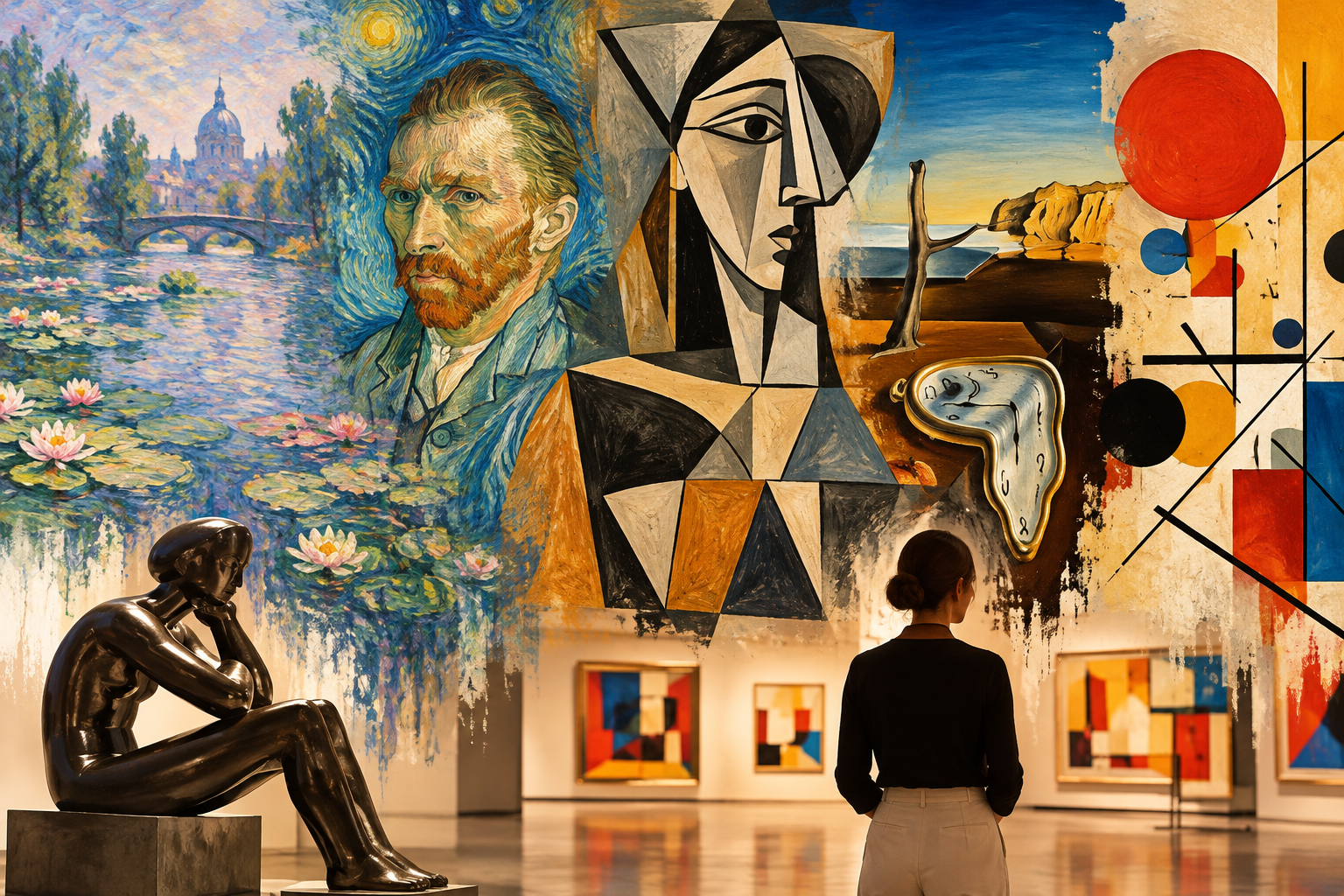
Modern art represents one of the great turning points in the history of visual culture. From the second half of the nineteenth century onwards, many artists began to question the academic rules that had shaped painting and sculpture for generations. Faithfully reproducing reality was no longer the only objective. Instead, artists explored new ways of experimenting with light, colour, composition and emotion.
This transformation did not belong to a single style or unified school. Modern art developed through a wide range of movements that reflected the social, technological and cultural changes of their time. Industrialisation, urban growth and new ideas about the individual all influenced how artists observed and represented their surroundings.
Understanding modern art helps us discover how creativity became a way to challenge conventions, explore new perspectives and expand the boundaries of visual expression.
What Is Modern Art and What Are Its Main Characteristics?
The term modern art generally refers to a period beginning in the second half of the nineteenth century and extending through much of the twentieth century, although its exact chronological boundaries vary depending on the historical approach. One of its defining characteristics is the desire to experiment and develop artistic languages beyond traditional models.
Modern artists began to place greater importance on personal interpretation, creative freedom and formal experimentation. In some works, brushstrokes became a central feature. In others, colour moved away from naturalistic representation, or figures were simplified into geometric structures.
Some of the most representative characteristics of modern art include:
- A break with traditional academic conventions.
- Experimentation with colour, light, composition and materials.
- The exploration of emotions, ideas and subjective experiences.
- New ways of representing and interpreting reality.
- The growing importance of abstraction and personal expression.
The Main Movements of Modern Art
The history of modern art is shaped by movements that emerged in different contexts and raised new questions about the purpose of images. Understanding their characteristics helps explain the diversity of styles now found in museums, galleries and collections.
Impressionism: Light as the Main Subject
Impressionism emerged in France during the nineteenth century and challenged established academic conventions. Artists such as Claude Monet, Pierre-Auguste Renoir and Edgar Degas explored the effects of light, movement and everyday scenes.
Their visible brushstrokes and interest in changing atmospheric conditions helped them capture fleeting visual impressions. Rather than idealising their subjects, many Impressionists observed urban life, landscapes and ordinary activities from a more immediate perspective.
Post-Impressionism: Personal Expression
Post-Impressionism brought together artists who developed individual approaches based on some of the innovations introduced by Impressionism. Vincent van Gogh used colour and brushwork to intensify emotional expression, while Paul Cézanne investigated the geometric structure of objects and landscapes.
These experiments contributed to the later development of abstraction, Cubism and other movements that placed greater emphasis on constructing an image rather than reproducing exactly what the eye could see.
Cubism: A New Way of Representing Reality
Developed primarily by Pablo Picasso and Georges Braque in the early twentieth century, Cubism transformed the representation of objects. Forms were broken down into geometric planes, and different viewpoints could appear within a single composition.
This break with traditional perspective influenced painting, sculpture, design and other visual disciplines. Cubism demonstrated that an artwork did not have to reproduce the appearance of an object from a single position.
Surrealism: The Power of Dreams
Surrealism explored dreams, the unconscious and unexpected associations. Salvador Dalí, René Magritte and Max Ernst developed images that combined recognisable elements in surprising ways, challenging the usual logic of everyday reality.
Its influence extended into literature, photography, cinema and many forms of contemporary creativity, particularly those concerned with imagination, symbolism and alternative ways of seeing the world.
Abstraction: Beyond Recognisable Forms
Abstract art made colour, line, rhythm and composition fundamental elements of an artwork without requiring recognisable objects or scenes. Wassily Kandinsky and Piet Mondrian were among the artists associated with the exploration of these possibilities.
Abstraction opened up a broad field of experimentation that continues to influence painting, graphic design, architecture and visual communication.
Artists Who Transformed Art History
The evolution of modern art is closely connected to artists who dared to investigate new forms of expression. Their careers show that artistic innovation can emerge from very different interests, including the observation of nature, reflection on identity, technical experimentation and the desire to challenge established rules.
Vincent van Gogh turned colour and brushwork into powerful vehicles for emotional expression. Pablo Picasso developed a career marked by successive stylistic transformations. Wassily Kandinsky explored the expressive potential of abstract forms, while Frida Kahlo created a deeply personal visual language shaped by identity, the body and lived experience.
These artists do not represent a single way of understanding modernity. Their differences reveal the richness of a period in which experimentation became an essential part of the creative process.
Modern Art in Spain
Spain has played an important role in the evolution of modern art through artists who developed distinctive visual languages and achieved international recognition. Pablo Picasso contributed decisively to the transformation of painting, while Joan Miró explored symbolic worlds and forms characterised by remarkable visual freedom.
Salvador Dalí became one of the most recognisable figures of Surrealism, and Juan Gris made an important contribution to Cubism. Their careers illustrate the diversity of Spanish contributions to twentieth-century artistic movements.
Cities such as Madrid, Barcelona and Valencia offer different opportunities to explore artistic heritage and contemporary creativity. Museums, exhibitions, galleries and cultural spaces reveal how local traditions can coexist with new aesthetic approaches.
How to Appreciate a Work of Modern Art
You do not need specialist knowledge to begin exploring modern art. A good starting point is to observe an artwork carefully before reading its explanation. Pay attention to its colours, shapes, composition and the details that first attract your attention.
It can also be helpful to ask questions: What feeling does the composition create? Does the artwork depict a recognisable scene, or do abstract forms dominate? How does the artist use light? What relationship exists between the title and the image?
Learning about the artist’s career and the historical context of the work can then enrich your interpretation. Over time, comparing different movements helps you recognise visual techniques, influences and different approaches to creativity.
Art Galleries and Spaces for Discovering New Perspectives
Art galleries play an important role in introducing artists and visual ideas to the public. Beyond displaying artworks, they can offer direct contact with different creative languages and bring visitors closer to new ways of interpreting contemporary culture.
Visiting exhibitions allows you to appreciate details that are often lost in digital reproductions, such as the actual dimensions of a painting, the texture of its surface or the relationship between the artwork and its surroundings.
The experience can also spark an interest in lesser-known artists and movements that are not always included in the most familiar art-historical narratives. Exploring different cultural spaces helps build a broader understanding of the artistic landscape.
Ultimately, discovering modern art is an invitation to look with curiosity, question first impressions and explore how creativity can transform our understanding of the world.
Frequently Asked Questions About Modern Art
When did modern art begin?
Modern art is generally considered to have emerged in the second half of the nineteenth century, with movements such as Impressionism, although its exact chronology depends on the historical approach used.
What are the main movements of modern art?
Some of the best-known movements include Impressionism, Post-Impressionism, Cubism, Surrealism and Abstraction, alongside other approaches that transformed visual creativity.
What is the difference between modern and contemporary art?
Modern art is generally associated with innovations developed from the late nineteenth century through much of the twentieth century. Contemporary art usually refers to artistic production from more recent decades and the present, although the boundaries can vary depending on the approach used.
Do you need to understand art to enjoy it?
No. Personal observation is an excellent starting point. Learning about the history and context of an artwork can deepen your interpretation, but it is not a requirement for enjoying it.